
Linn County VINELink Coverage
Kansas VINE is the state’s victim-information and notification service for adult offenders in participating county jails. Linn County Jail is the relevant local custody source to check. VINE receives information from a participating agency and makes selected status and event details available through VINELink. It can also send notices when an offered custody event occurs. The originating jail still controls the underlying booking, transfer, and release record.
The service is designed around a specific person, not a complete Linn County release list. Searchers should begin with a full name and add an available offender or inmate identifier when the interface permits it. A result can identify the reporting agency, current custody location or status, and events supplied by that agency. Those fields are useful for personal knowledge, release planning, and notification. They may not explain why custody ended or where the person went.
Search Linn County VINELink Records
Open the official Kansas VINELink state view and select the custody or offender search. Use the details already known from the Linn County roster or a court case. Similar names can produce several matches. Do not merge the age, identifier, location, or event from one record with another person’s name.
- Choose Kansas before entering the person’s information.
- Enter the last and first name, checking spelling and known aliases.
- Add an available inmate or offender ID when the search offers that field.
- Compare the reporting agency, age or birth detail, identifier, and custody location.
- Open only the record whose combined details identify the intended person.
- Note the event wording and agency, then confirm it with that agency.
If the person recently appeared on the official Linn County live roster, record the displayed inmate number, name, booking time, case information, and hold reasons before the row disappears. Those facts make the VINELink match and later records request more precise. The roster is current-only. Its disappearance cannot identify a bond release, a transfer, a farm-out to another jail, a KDOC commitment, or pickup on another hold.
Read Linn County Release Events
VINELink reports what the participating source sends. The labels and available fields can differ by record. Treat an event as a lead tied to a named agency, not as a complete release sheet. A release event may show that the source reported an exit, yet omit whether it followed bond, time served, dismissal, a court order, or another legal basis.
| VINELink item | What it can establish | What still needs confirmation |
|---|---|---|
| Reporting agency | Which participating source supplied the entry | Whether another agency now holds the person |
| Custody status | The status last reported to VINE | The sheriff’s actual release disposition |
| Location | A facility or agency associated with the record | Community release versus transfer |
| Offender identifier | A way to separate similar names | Identity across unrelated agency systems |
| Release or custody event | The event wording and time supplied, when available | Release type, authority, and destination |
A transfer is not community release. Linn County commission records separately describe releases and farmed-out prisoners, showing why the distinction matters locally. Likewise, an “other agency” hold may result in pickup rather than freedom. The jail release/disposition entry and receiving-agency record resolve that question.
Set Linn County Release Alerts
Registration is prospective. It works best while the correct record is active and the desired event is offered. The available channels and event choices appear on the individual record. Phone alerts commonly require a personal identification number, or PIN, to acknowledge the call. Text and email channels may require a verification step.
- Open the correctly matched person record.
- Select “Register for Notifications” or the equivalent alert control.
- Choose release or other offered custody-change events.
- Select phone, text, or email from the channels shown.
- Enter the destination carefully and complete the displayed confirmation.
- Create the requested telephone PIN and keep it private.
- Save the registration details for later reference.
When an alert arrives, read the event name and reporting agency before taking the next step. A release notice should be checked against the Linn County Sheriff’s record. A transfer notice should lead to the receiving agency. Delays can occur because VINE depends on agency data, so the alert time is not necessarily the exact time an event was processed at the jail.
The official Kansas VINELink screen shows the state search and notification entry used for this process.
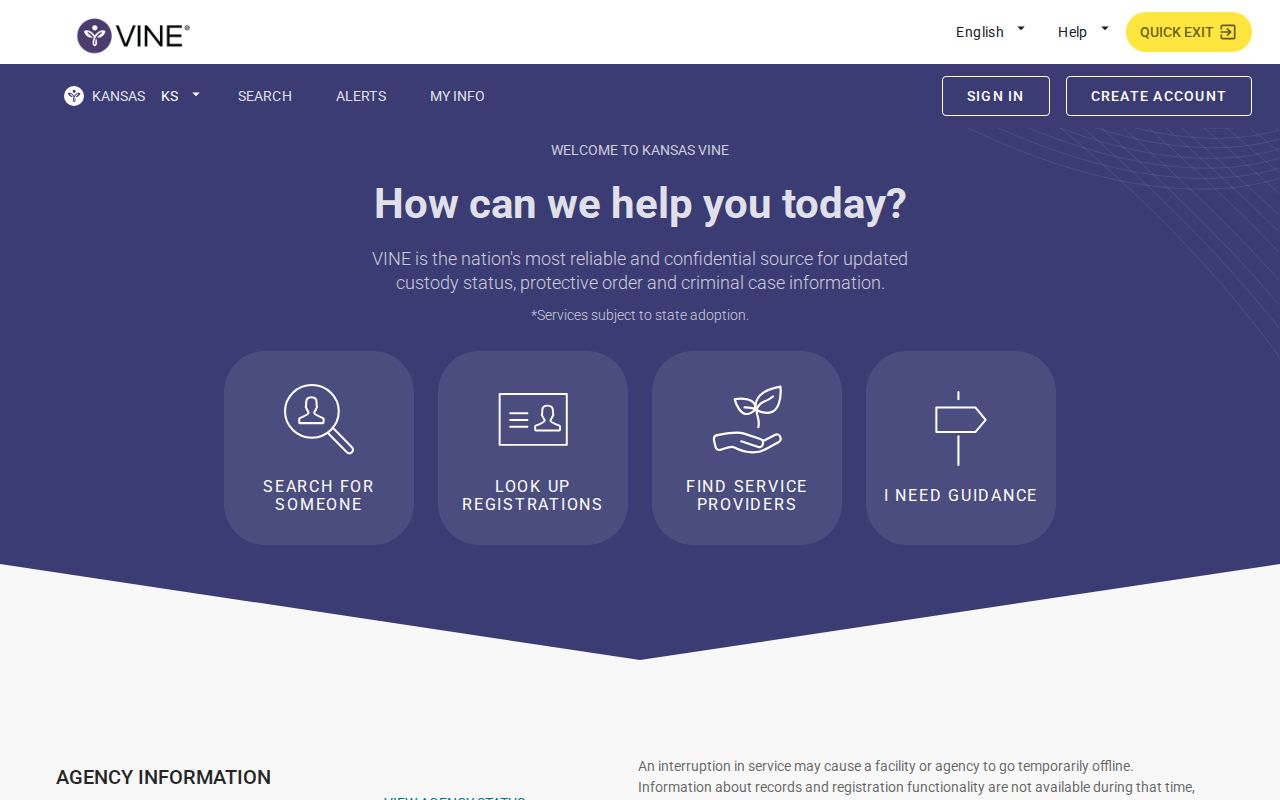
The screen is the proper starting point for a Kansas county-jail alert, but the matched record and its source agency determine what the resulting notice means.
Kansas Prison Records Use KASPER
The most important local coverage limit is easy to miss. The Kansas Attorney General states that Kansas VINE does not include KDOC offenders housed in state prisons. A Linn County case that ends in commitment to the Secretary of Corrections therefore moves outside the county-jail VINE path. Search KASPER, the Kansas Adult Supervised Population Electronic Repository, for that state record.
KASPER covers people sentenced to the Secretary of Corrections since 1980, including incarcerated, supervised, and discharged people. It can show a photograph, conviction and sentence data, movements, location, parole office, supervision information, and an “Anticipated release date.” That date is a forecast. It is not proof that an exit occurred. Movement history, released or discharged status, and an official KDOC record provide stronger confirmation.
A county-only booking does not create a KASPER entry. Search KASPER only when the case or release disposition points to KDOC custody. Someone under parole or postrelease supervision has left prison but may still be serving the community portion of a sentence. A discharged status indicates a different endpoint.
Missing Linn County VINELink Results
No result is not a release result. Spelling, aliases, timing, agency participation, record matching, and system coverage can all explain an absence. Try known name forms and identifiers, then return to the system that owns the custody event. For a Linn County jail booking, that is the Sheriff and the court docket. For a state sentence, it is KDOC and KASPER.
The current Linn County roster shows people who remain listed, but offers no release archive. A person can leave it because of release, transfer, farm-out, state commitment, or another hold. Check the Kansas District Court Public Access Portal for filed events and orders. Then request the existing booking-and-release sheet or jail-management disposition entry. Ask for actual release date and time, release type, authorizing agency, and destination or receiving agency if recorded.
Case and hold details can point outside Linn County. The local roster may display another county’s case prefix, a probation or parole violation, or a general other-agency hold. Follow the case number to the court that issued it. If another custodian took control, request the receiving agency or destination from the jail record and continue with that agency’s locator. This prevents a local roster change from being mistaken for the end of all custody.
- Release
- An authorized exit from the reporting custodian, which still may lead to another custodian.
- Transfer
- A move between facilities or agencies without ending custody.
- Discharge
- The end of the sentence obligation shown by the responsible corrections system.
- Postrelease supervision
- Community supervision that follows the prison portion of a Kansas sentence.
Federal Releases Need Federal Records
VINELink is not the federal inmate locator. If the facts point to a federal prosecution or Bureau of Prisons custody, use the Federal Bureau of Prisons Institutions path and the official BOP Inmate Locator. A past “Released” date means the person left BOP custody as of that date. It does not rule out federal supervision or custody held by a state, county, or immigration agency.
Immigration custody has a separate ICE Detention System locator. Use it only when an immigration hold or transfer is supported by the case facts. A disappearance from the Linn roster while another-agency or ICE custody is possible does not prove return to the community. Federal court dockets, BOP results, ICE records, and agency requests each answer different parts of the chain.
Confirm Linn County Releases
For a Linn County Jail event, direct confirmation comes from the Sheriff’s booking-and-release record. Identify the person, inmate or booking number, booking date, and case number. Ask for the existing release/disposition entry and any recorded destination. The Sheriff’s Office operates from the Justice Center at 308 Main Street, Suite 103, Mound City, Kansas. Public office hours are Monday through Friday, 8:00 a.m. to 4:00 p.m.
The Kansas District Court Public Access Portal can add the filed court event behind a bond, dismissal, sentence, or probation order. A docket entry establishes the court action, while the jail record establishes how and when staff processed the departure. Neither should be replaced by a VINELink alert. When remote court detail is limited, the Linn County District Court clerk is the source for public filed orders and copies.
Kansas VINE remains useful because it can send a prompt signal. It should sit beside, not replace, the source record. The Linn County released inmate search compares the county, court, KDOC, federal, and immigration routes. Use the route that matches the agency named in the event, and preserve the exact wording rather than turning every custody change into a community release.
Keep the alert confirmation, note the time received, and record the agency named in it. Those details help the records office locate the matching custody event without asking it to guess which person or booking is involved.