
Federal Release Routes Near Linn
The Federal Bureau of Prisons operates a nationwide system for people serving federal sentences. No BOP institution was identified in Linn County, Kansas. The facility entry represents that national system because a supported federal case can move a person far outside the county. The United States Marshals Service often handles federal pretrial detention and transportation before BOP designation.
A person can leave Linn County Jail with the Marshals or another federal agency and remain confined. Later departure from BOP may be release to the community, completion of the custodial sentence, transfer to another sovereign, immigration custody, or another event described by federal records. Federal supervised release can continue after imprisonment. It is imposed by the court and is not the same as BOP physical custody.
The county release sheet should identify a receiving agency when Linn transfers custody. The federal docket then establishes the federal charge, detention orders, judgment, and supervised-release term. BOP becomes the public locator after the person falls within its records.
Search Federal Release Records
Use the official BOP Inmate Locator for federal inmates from 1982 to the present. Search by a federal register number when known. A name search should be narrowed and matched with age, race, sex, and other displayed identity information. Similar names must not be combined.
- Confirm federal involvement from the docket, hold, transfer destination, or register number.
- Search the locator by register number when available.
- Otherwise enter the complete name and compare all displayed identity fields.
- Open or record the location and release information exactly as displayed.
- Check the federal court docket for judgment, sentence, release authority, and supervision.
- If another custodian received the person, continue with that agency’s record.
A Linn County case remains on the county path unless facts establish a federal prosecution or transfer. The Linn County released inmate search separates those systems so an empty county result is not used as a reason to search every national database.
Interpret BOP Released Results
A BOP record with a past release date and no institution, or a location shown as “RELEASED,” means the person is no longer in BOP custody as of the displayed date. That is a custodian-specific fact. It does not prove that every form of custody or supervision ended. State or local custody, immigration detention, and federal supervised release can still exist.
“IN TRANSIT” is not release. A “Not in BOP custody” message can require context because the person may have been released, transferred outside BOP, or occupy another status described by the agency. BOP’s own release statistics exclude transfers to another custodial jurisdiction, including state, treaty-transfer, and ICE destinations. This reinforces the difference between leaving BOP and returning to the community.
| BOP result | What it supports | What to check next |
|---|---|---|
| RELEASED with date | BOP custody ended by the shown date | Court supervision and other custody |
| IN TRANSIT | Movement within a custody process | Later BOP location or agency record |
| Current institution | Present BOP listing | Facility and projected-release information |
| Not in BOP custody | No current BOP custody under the result | Record explanation, docket, and other custodian |
BOP Record Date Limits
BOP states that its locator covers federal inmates from 1982 to the present. Older federal custody may require archival or agency records rather than the online search. Historical release and sentence information can also change after recalculations, court action, or legal developments. Save the register number and recheck the official result when timing matters.
BOP’s official records explanation describes how release data and custody results should be read.
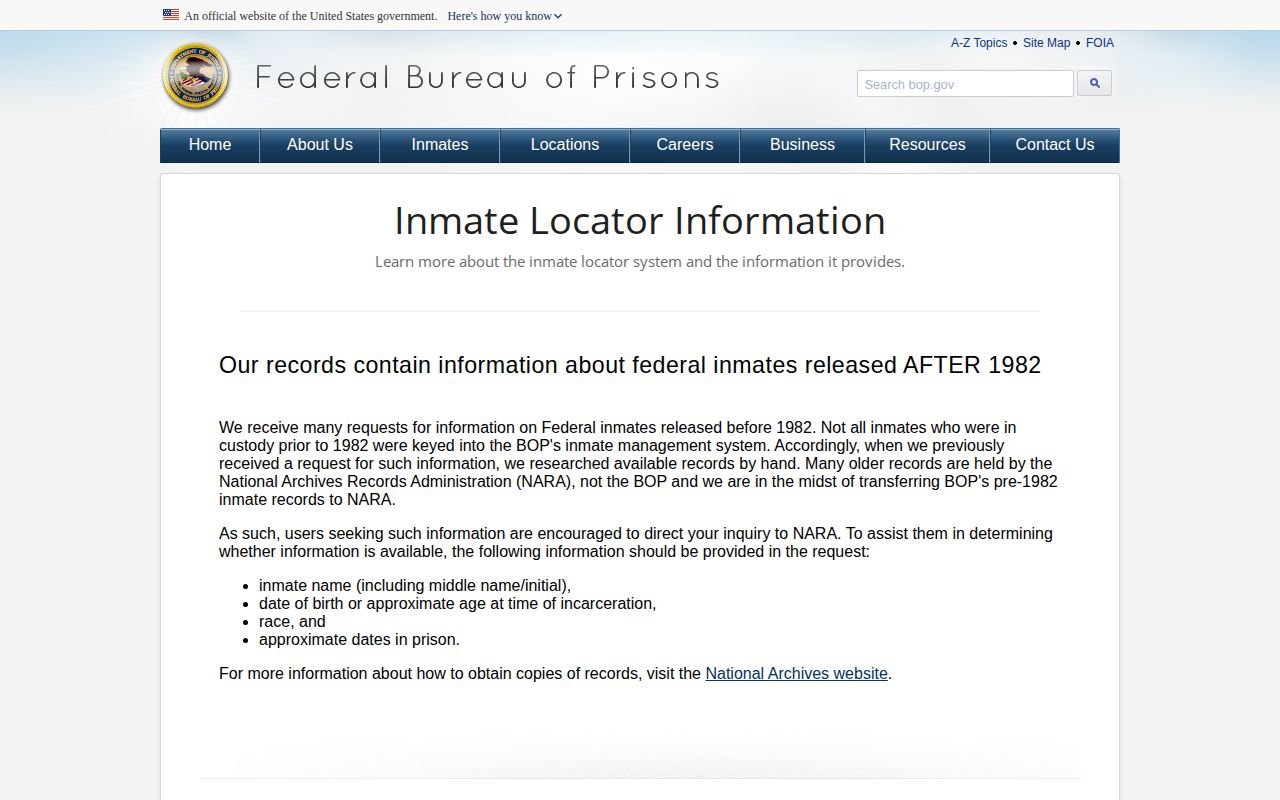
The explanation is the correct source for result vocabulary and historical limits. A commercial profile or copied result should not replace the current federal record.
If an online result conflicts with a court order or known movement, use the register number, case number, dates, and named institutions in a focused agency inquiry. The docket explains legal authority, while BOP records explain federal sentence custody.
Federal Court Release Records
The federal court docket is the durable route for detention and release orders, acquittal, dismissal, judgment, sentence, and supervised release. It can establish why federal custody changed. The BOP locator usually supplies the public custody endpoint after designation, but it does not reproduce the full court history.
A person held by the Marshals before trial may never appear in BOP as a sentenced prisoner. The Marshals use contracts and transfers rather than a county-style nationwide public pretrial locator. For that person, follow the federal docket, the known detention facility, and identifiable USMS records. A purpose-neutral request should name the person, federal case or register number, date range, and specific custody, release, or transfer record.
Federal court supervision after prison is administered through the court and probation system, not shown merely by a BOP “Released” location. Read the judgment for the term and conditions, and use later docket entries for modification or revocation activity where public.
Federal Records and Contact
BOP location and release questions begin with the official locator and its records guidance. A request should include the complete name, federal register number, date of birth where appropriate, institution, court case, and narrow date range. Ask for an existing releasable record rather than a narrative answer.
Nationwide federal correctional system
Official Inmate Locator
Search by register number or matched name
For USMS custody and transfer material, use the U.S. Marshals FOIA process. Federal privacy and law-enforcement exemptions can restrict disclosure. A request does not guarantee access to every field, and the agency need not create a special release list.
Linn County should receive a separate request for its own jail disposition when the person departed the Justice Center in federal custody. One agency’s file should not be treated as a substitute for another agency’s source record.
From Linn Jail to Federal Custody
A federal handoff can begin with a hold reason, federal warrant, court order, or receiving-agency entry. Record those details while the person remains on the Linn roster. When the row disappears, ask the Sheriff for the actual release or transfer time and destination. “Released to USMS” would mean Linn’s physical custody ended and federal custody began.
The county court portal will not replace a federal docket. Search the correct federal court using the case information. If the person later receives a federal sentence and BOP register number, use the national locator. If the person was released or acquitted before BOP designation, use the federal docket and Marshals or holding-facility record.
Federal and ICE Transfers
BOP departure can lead to immigration custody. A BOP result alone cannot show the complete ICE outcome, and ICE uses a separate locator. If records identify an immigration handoff, continue with the ICE Detention System. If they show a state or county transfer, use that receiving jurisdiction instead.
Likewise, a person can be returned to Kansas or another state on a warrant after federal custody. Search the current holding record and the issuing court. The word “released” should always be qualified as released from BOP, from Linn County Jail, or from another named custodian.
- Federal register number
- The identifier used to match a person in BOP records.
- Designation
- BOP assignment of a sentenced person to an institution.
- Supervised release
- Court-ordered federal community supervision following imprisonment.
- Transfer
- A custody handoff that does not mean return to the community.
Confirm Federal Release Outcomes
The strongest confirmation combines three layers when they exist: Linn County’s transfer or release disposition, the federal court’s authority and sentence, and the BOP or Marshals custody record. Each answers a different question. A single missing name or locator message cannot establish the full chain.
Use exact dates and identifiers. Compare the BOP release date with the docket and any receiving-custodian entry. If they conflict, ask the record-owning agency for clarification or a releasable movement record. Do not infer community return where a transfer, immigration hold, or state warrant remains possible.