
Linn Parole Versus Probation
Kansas uses several labels for community supervision. Parole is a discretionary release process that chiefly applies to parole-eligible indeterminate, pre-guidelines, and certain specified sentences. Postrelease supervision usually follows the prison part of a determinate Kansas sentencing-guidelines sentence. In that setting, the sentence and earned credits control the release point, while the Prisoner Review Board sets conditions. Probation is different. A judge can order it in place of prison, after a county jail term, or as part of another court disposition.
The agency matters because no single Linn County parole and probation database is complete. KASPER, the Kansas Adult Supervised Population Electronic Repository, is the main public source for KDOC parole and postrelease status. Court probation is confirmed through the criminal docket and Sixth Judicial District Community Corrections. KDOC warns that KASPER community-corrections probation events have not been current since April 21, 2021 during data modernization.
| Status | Who orders or controls it | Best Linn County check |
|---|---|---|
| Parole | Kansas Prisoner Review Board and KDOC | KASPER, then Olathe Parole Office |
| Postrelease supervision | Sentence law, PRB conditions, and KDOC | KASPER supervision type and parole office |
| Probation or community corrections | Sentencing court | Court docket and Linn Community Corrections office |
| Discharge | Controlling court or KDOC, depending on status | Discharge filing, KASPER status, or PRB certificate |
- Parole
- Conditional release from an eligible prison sentence before maximum-sentence discharge.
- Probation
- Court-ordered supervision that can occur without a state-prison term.
- Postrelease supervision
- Supervision that follows the prison portion of most qualifying determinate sentences.
- Discharge
- The formal end of the sentence or supervision obligation controlled by that agency.
Verify Linn Post-Release Supervision
Begin with the sentence source, not a broad name search. Someone who served a Linn County Jail sentence or received probation may never appear in KASPER. Someone sentenced to the custody of the Kansas Secretary of Corrections should have a KASPER record. Match the full name with a KDOC number, date of birth, conviction county, case details, and movement dates whenever possible.
- Search KASPER by KDOC number or name. Use Conviction County set to Linn when appropriate, or Parole Supervision County to find a person supervised locally after a conviction elsewhere.
- Open the matching detail. Read supervision type, status, movement history, discharge information, and the listed parole office together. A parole office entry supports supervision, not the exact county jail release time.
- If the sentence was probation, search the Kansas District Court Public Access Portal by exact name or case number. Look for the probation order, later violation entries, and discharge filings.
- Contact the office that owns the record. Use the Olathe Parole Office for KDOC parole or postrelease status, and Sixth Judicial District Community Corrections for current court probation.
- When release itself is unclear, pair the supervision record with the Linn County Sheriff booking-and-release record. The Linn County released-inmate search paths explain how to obtain that event.
Do not treat a name’s absence as discharge. KASPER can omit local probation updates, while a court portal can omit older, sealed, expunged, restricted, or non-electronic material. The originating office can distinguish a data gap from a supervision change.
Linn Supervision Office Routes
Linn County uses two office routes. KDOC’s official contact list assigns the county to the Olathe Parole Office in the North Region. The local Sixth Judicial District office handles community-corrections probation. Calling the wrong office can produce an apparent “no record” even when the other system has the case.
KDOC Olathe Parole Office
804 North Meadowbrook Drive, Suite 100
Olathe, KS 66062
913-829-6207
Automated Reporting System: 866-570-7225
Sixth Judicial District Community Corrections, Linn Office
308 Main Street, Suite 106
Mound City, KS 66056
913-795-2630
The official district-office listing shows the Linn Community Corrections route.
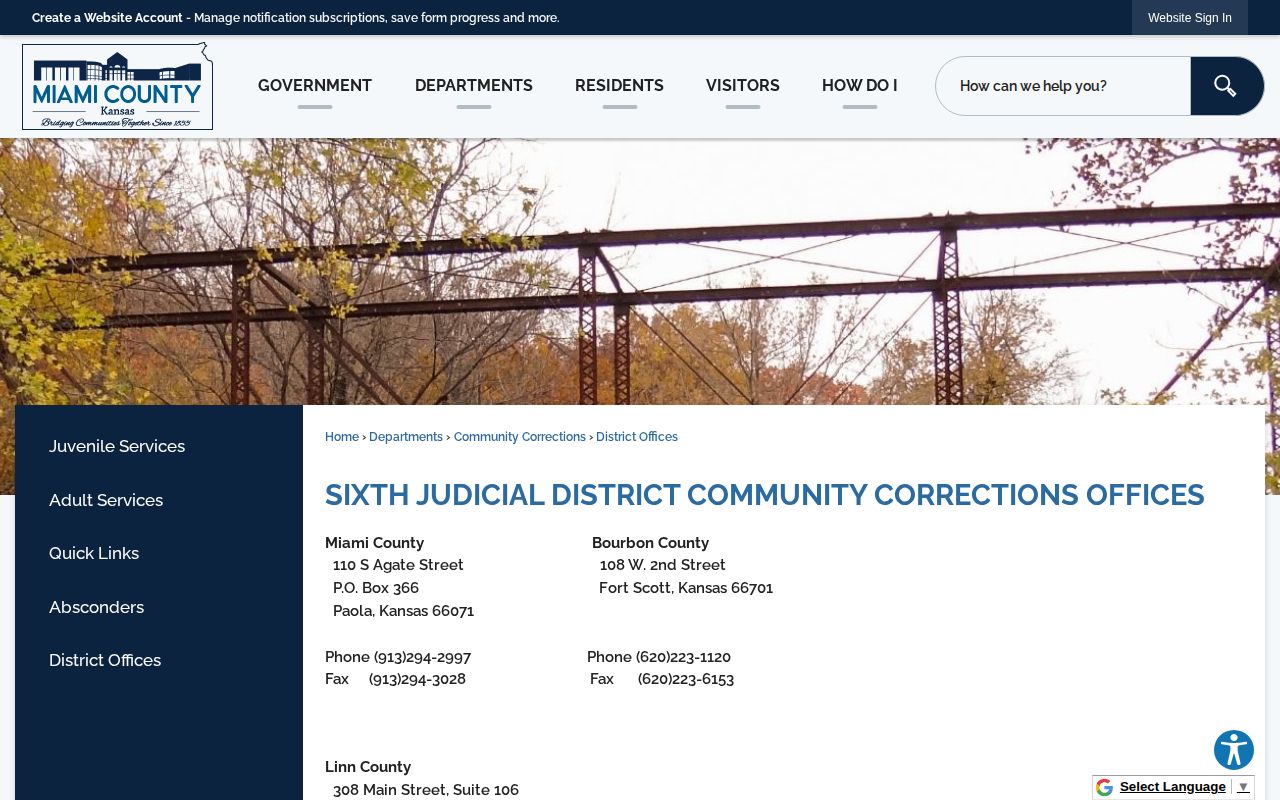
The image helps confirm that local court probation and KDOC parole are separate contact paths.
Linn Violations and Absconders
An absconder is a person whom the supervising agency alleges has stopped reporting or maintaining required contact. It does not mean the sentence ended. It also does not prove that the person is now in custody. KASPER offers parole-absconder and community-corrections-absconder searches, but its data updates each working day and a status may change after an update. KDOC’s Enforcement, Apprehensions and Investigations absconder line is 785-414-7755.
The Linn County current roster may list a parole violation, probation violation, warrant, or other-agency hold. That is evidence of a new custody listing on the displayed date. Preserve the case or warrant number, identify the issuing court, and then reconcile the booking with KASPER and the court case. A violation booking does not erase the fact that an earlier prison or jail custody period ended.
Kansas VINELink may provide a custody-status alert for a participating county-jail record. It does not report supervision conditions and Kansas VINE excludes offenders housed in state prisons. Confirm a return to state custody through KDOC.
Note: A supervision violation, warrant, and sentence discharge are distinct events and should never be inferred from one roster label.
How Linn Supervision Ends
Community supervision ends through a formal record, not simply because a person is no longer easy to find online. For court probation, look for a discharge or satisfaction filing in the original criminal action. A revocation can instead send the person to jail or prison. For KDOC supervision, read KASPER’s status and movement history. A sentence-discharge entry or Prisoner Review Board maximum-sentence discharge certificate is stronger evidence that the applicable sentence was satisfied and no PRB or KDOC supervision remains.
Conditional release and maximum-sentence discharge also have separate meanings. Conditional release can leave supervision in place. Maximum-sentence discharge indicates the controlling sentence obligation has reached its end, subject to verification against the person’s full set of cases and holds. If a person has more than one jurisdiction involved, one case can discharge while another remains open.
The court docket may show probation discharge, revocation, or an amended order. KASPER may keep a discharged person’s record because it covers people sentenced to the Secretary since 1980. A persistent result is not proof of active supervision. Conversely, an empty portal result does not prove discharge because access limits and expungement can affect public display.
Expungement has its own clock and should not be confused with discharge. Under Kansas law, the waiting period for many eligible cases runs from satisfaction of the sentence or discharge from probation, community corrections, parole, postrelease supervision, conditional release, or a suspended sentence. It does not necessarily begin when jail custody ends. Offense type and disposition affect eligibility, and some cases cannot be expunged. The filed discharge record is therefore useful when a person later needs to establish when supervision ended through a court process.
Linn Parole Board Records
The Kansas Prisoner Review Board publishes monthly public-comment session schedules and lists of upcoming offenders. Those lists can show that a parole process is approaching, but they are not a person-level decisions database. For an outcome, check KASPER after the event or request the relevant PRB record from KDOC.
The official public-comment schedule shows how the board organizes upcoming sessions.

This schedule supports timing research, while the supervision status still requires a KASPER or KDOC check.
For most post-1993 determinate grid sentences, release to postrelease supervision is not a traditional discretionary parole decision. The prison portion, credits, and governing statutes establish the transition. Legacy indeterminate and specified off-grid sentences may instead use parole-eligibility thresholds and a board decision. This is why the sentence type must be known before interpreting a PRB listing.
Correct Linn Release Errors
Linn County detention staff release prisoners only after proper authorization and return personal property and clothing during processing. If property is missing or a booking-and-release field is wrong, start with the Sheriff and identify the exact booking. Ask for the existing release sheet or jail-management disposition entry rather than asking staff to reconstruct events from memory.
The county KORA request form is the documented records route. Include the full name, booking or inmate number, booking date, court case, and the precise field needing review. Request actual release date and time, disposition, authorizing court or agency, and receiving agency if the event was a transfer. Email delivery has no delivery charge under the county schedule, though search, review, redaction, and compilation time can be billed.
A different correction route applies to each source. Send a KASPER data concern to KDOC at kdoc_pub@ks.gov. Send a docket error to the Linn County District Court clerk. A Sheriff correction does not change a KDOC sentence record, and a KASPER correction does not revise a court order. Keeping those records separate protects the meaning of Linn County parole and probation status.
When an error affects release and supervision at once, collect the records before asking for a change. The Sheriff’s sheet should identify the jail event. The court order should identify probation or commitment. KASPER should identify KDOC custody, supervision, movement, and discharge. Compare names, numbers, dates, and the controlling case. A concise request that points to the conflicting field gives each custodian a clear issue to review and avoids treating one agency’s record as authority over another.