
Linn Projected Versus Actual Release
KASPER uses the official label Anticipated release date. It is a calculated future date based on the sentence structure and credits known to the Kansas Department of Corrections. It is not proof that a release took place. The date can move, and the public database updates each working day rather than continuously.
Scheduled versus actual release: a projected or anticipated date is an estimate in a sentence calculation. Actual release requires a later status, movement, discharge, or agency release record.
A pretrial detainee at Linn County Jail normally has no sentence-based projected release date. The next event may turn on bond, dismissal, a plea, a court order, or another agency’s hold. Even a bond amount on the live roster does not show that bond was posted. For a sentenced county inmate, use the judgment, jail-credit entry, and the Sheriff’s calculation. For a state prisoner, use KASPER and KDOC’s Sentence Computation Unit.
The custody that ends must also be named. Departure from Linn County Jail may mean community release, transfer, state commitment, or pickup on a warrant. State-prison release may lead to parole or mandatory postrelease supervision. A maximum-sentence discharge has a different meaning. The actual disposition and receiving agency resolve those differences.
Find Linn Projected Release Dates
Choose the route from the current custodian. KASPER covers people sentenced to the custody of the Kansas Secretary of Corrections since 1980 who are incarcerated, supervised after prison, or discharged. It does not cover every person held in Linn County Jail. A defendant who bonded out, served a local sentence, or received probation may never have a KASPER profile.
- Identify whether the person is in county, state, federal, or immigration custody. The Linn County release search provides the full custody-type decision path.
- For a state prisoner, open the KASPER search. Search by KDOC number when known or use name and identity filters.
- Match the detail by date of birth, KDOC number, conviction county, case, and movement history. Then locate the Anticipated release date field.
- For a county sentence, obtain the judgment and jail-credit entry from the court, then ask Linn County Jail for its calendar computation. Do not apply a KDOC percentage to the local term.
- For an exact state calculation, contact the KDOC Sentence Computation Unit at 785-296-3317. Ask which sentence, credit, or hold controls the displayed date.
KDOC’s official locating and field guide explains the KASPER record and its coverage.

The field guide helps distinguish the anticipated date from supervision and discharge fields shown elsewhere in the record.
Kansas Good-Time Release Computation
For many Kansas crimes committed on or after July 1, 1993, K.S.A. 21-6821 allows maximum good time of 15 percent of the prison portion. The phrase “serve 85 percent” is only arithmetic shorthand for full retention of that maximum credit. It is not a universal Kansas rule. Credit must be earned and kept, and offense date, grid level, sentence type, and exclusions matter.
Specified nondrug severity-level 7 through 10 offenses committed on or after January 1, 2008 may receive a maximum of 20 percent. If all eligible credit remains, that implies an 80-percent floor. Statutory date and severity rules also allow 20-percent treatment for specified drug-grid sentences. Some eligible people serving only designated nondrug level 4 through 10 or qualifying drug-level sentences can earn up to 120 days of program credit after successful completion of designated programs, subject to exclusions.
Other provisions change the result. Good time can be withheld or forfeited. For certain sexual offenses, credit removed from prison time is added to postrelease supervision. Special off-grid and life sentences can have statutory thresholds or exclusions that do not follow the ordinary 15-percent calculation. Never multiply the pronounced sentence by 85 or 80 percent and present the product as an official Linn County projected release date.
The current Kansas good-time statute shows the controlling categories.
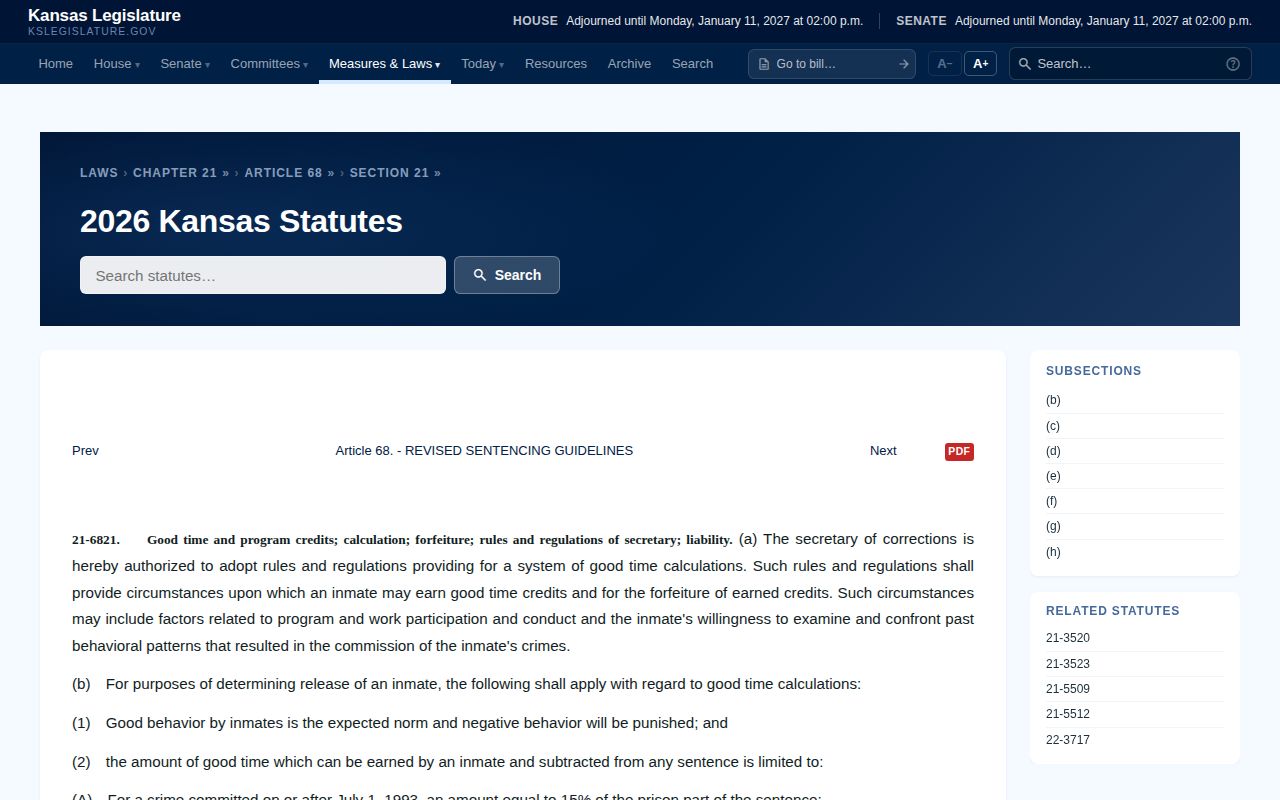
The statutory text is the source for the 15-percent and 20-percent exceptions, while KDOC applies those rules to the individual sentence.
Why Linn Release Dates Change
An anticipated date is recalculated when an input changes. Some changes affect sentence length. Others do not alter the date itself but prevent community release to the expected place. A detainer is a request or legal basis for another agency to take custody. It can turn a planned exit from one facility into a transfer.
| Factor | Effect on the date or outcome | Best source |
|---|---|---|
| Good-time loss or restoration | Changes credited prison time | KDOC sentence and disciplinary record |
| Program credit | May reduce eligible terms after approved completion | KDOC computation |
| Amended or vacated sentence | Changes the legal term being calculated | Court order and KDOC |
| Corrected jail credit | Changes time already credited against the sentence | Court and computation unit |
| Concurrent or consecutive terms | Changes which term controls the endpoint | Judgment and KDOC computation |
| Detainer or new warrant | May cause continued custody or transfer instead of community release | Holding agency and issuing court |
| Parole decision | Affects eligible legacy or specified sentences, not most determinate postrelease transitions | PRB record and KASPER |
Before release, K.S.A. 22-4605 requires the custodian to query available state and federal databases for outstanding warrants. A newly confirmed warrant can produce a late change in destination even when the booked sentence reached its expected end. Ask for the final release disposition and receiving agency instead of assuming the earlier date guaranteed release to the community.
Timing can also change without a new sentence. KASPER’s working-day update schedule creates a public-display lag. A date that remains visible on the morning of the event may be replaced later by movement or supervision information. Save the date and time of the search, then ask the custodian for the transaction record when an exact sequence is needed.
Confirm Linn Actual Release
After the anticipated date passes, return to the correct source. A KASPER movement, supervised status, sentence discharge, or facility change can show what happened in the state system. KDOC updates on working days, so a same-day event may not yet appear. If timing matters, call the holding institution or Sentence Computation Unit.
For Linn County Jail, request the booking-and-release sheet or jail-management disposition entry. Ask for actual release date and time, release type, authorizing court or agency, and destination or receiving agency. The live county roster is current-only and has no release archive. A missing name is a lead, not confirmation.
Use the VINELink inmate check for a participating Kansas county-jail record and release notifications. Kansas VINE covers adult offenders housed in county jails but excludes KDOC prisoners housed in state institutions. A VINE event is secondary evidence and may not explain bond, time served, or transfer. Confirm it with Linn County or KDOC.
Note: Projected dates estimate an exit; movement and release records establish the event that actually occurred.
Linn Postrelease Versus Parole Dates
K.S.A. 22-3717 supplies the parole and postrelease framework. Most post-1993 determinate grid sentences, apart from specified off-grid cases, do not wait for a discretionary parole grant at the end of the prison portion. They move into mandatory postrelease supervision under the sentence structure. The Prisoner Review Board sets conditions rather than deciding ordinary suitability for release in the traditional sense.
Legacy indeterminate sentences and specified off-grid terms work differently. They can use parole-eligibility dates, board review, or statutory 15-, 20-, or 25-year thresholds. Life without parole and listed murder or off-grid categories have special exclusions. An eligibility date is not a promised release date, and a public-comment listing is not a grant.
The Prisoner Review Board process illustrates those distinct decision paths.

The process record helps identify when a board decision matters and when the calculated determinate-sentence date is the better starting point.
Linn County Jail Date Computation
Linn County’s live roster does not publish projected local release dates. The detention description says staff calculate calendar entry and release dates, but research found no published local good-time policy or weekend early-release rule. That absence is important. KDOC’s 15-percent and 20-percent provisions should not be borrowed to estimate a county sentence.
Start with the sentencing order. Identify the term imposed, effective date, and whether credit was awarded for days already held. Check for more than one case, concurrent terms that run together, consecutive terms that run one after another, and holds from other agencies. Then ask the jail which order and credit entry control its calendar. A court amendment or corrected jail-credit order should be reconciled with the jail calculation.
A person held before trial has a different path. Bond may permit release if posted and if no other hold blocks it. Dismissal can authorize release only when no second case, warrant, or agency hold remains. Commitment to KDOC ends county jail custody but begins or continues state custody. The Sheriff’s final disposition identifies which event occurred.
Which Linn Sentence Controls?
A projected release date can look inconsistent when several sentences overlap. KDOC must identify the controlling sentence and apply concurrent or consecutive structure, jail credit, earned good time, program credit, and any court changes. The public KASPER field displays the result, not the full arithmetic behind it. That is why a hand calculation from one docket line can differ from the agency date.
Ask precise computation questions. Provide the KDOC number and case number, then ask which sentence controls, what jail credit is recorded, whether the terms run together or in sequence, and which statutory credit category applies. If the answer differs from the judgment, obtain the actual filed order before requesting correction. KDOC accepts KASPER data concerns at kdoc_pub@ks.gov, while the court must correct its own docket or judgment.
Keep the anticipated date with the search timestamp and the identifiers used to find the record. If a later KASPER result differs, compare movement history before concluding the first date was wrong. A restored credit, forfeiture, corrected jail credit, new controlling sentence, or court amendment may explain the revision. KDOC can confirm the calculation it owns. The Linn County District Court can provide the filed order it owns. The Sheriff can confirm a county-jail release event. This source-by-source check preserves the difference between a revised projection, a transfer, and an actual release.
The same source separation applies after release. A court order supplies the legal sentence. KDOC computes and records a state-prison date. Linn County Jail computes its local calendar. VINELink reports custody events from participating county facilities. None should be treated as a substitute for the record owned by another agency.