
Kansas Prison Release Routes
The Kansas Department of Corrections, or KDOC, operates a statewide prison and community-supervision system. A Linn County judgment committing a person to the Secretary of Corrections can lead to placement at any institution assigned by KDOC. The county facility map identifies no Kansas state prison physically located in Linn County. This page therefore represents a serving system, not a local building.
Leaving prison can lead to parole, conditional release, postrelease supervision, or sentence discharge, depending on the sentence. Parole is a discretionary release process for eligible sentence types. Postrelease supervision generally follows the prison portion of a modern determinate sentence. Discharge means the sentence obligation has ended. A supervised person has left prison but has not necessarily completed the sentence.
The durable public route is KASPER, the Kansas Adult Supervised Population Electronic Repository. A state movement or release record establishes the custody transition. KASPER status and parole-office information can show the community phase, while a maximum-sentence discharge certificate is stronger evidence that applicable KDOC and Prisoner Review Board obligations ended.
Search KASPER Release Records
Begin at the official KASPER search disclaimer. Agree to the terms, then search by name or KDOC number. Name searches can use aliases and filters to separate matches. Conviction County can be set to Linn. Parole Supervision County can locate a person supervised in Linn even when the conviction came from somewhere else.
- Enter the KDOC number when known, since it is the strongest public search key.
- Otherwise search the full name and include aliases if supported by known records.
- Use birth, age, race, gender, county, and photo fields only to resolve identity.
- Open the detail and compare the conviction, case, sentence, and movement information.
- Read present status, location, supervision type, parole office, and discharge data together.
- Request the official movement or discharge record when exact release proof is needed.
KASPER covers people sentenced to the custody of the Secretary of Corrections since 1980 who are incarcerated, under post-incarceration supervision, or discharged. It does not cover every person booked into Linn County Jail. Bond release, a county sentence, local probation, or a dismissed county case may never create a KDOC record.
KDOC’s official locating guide describes the public fields and population covered by KASPER.
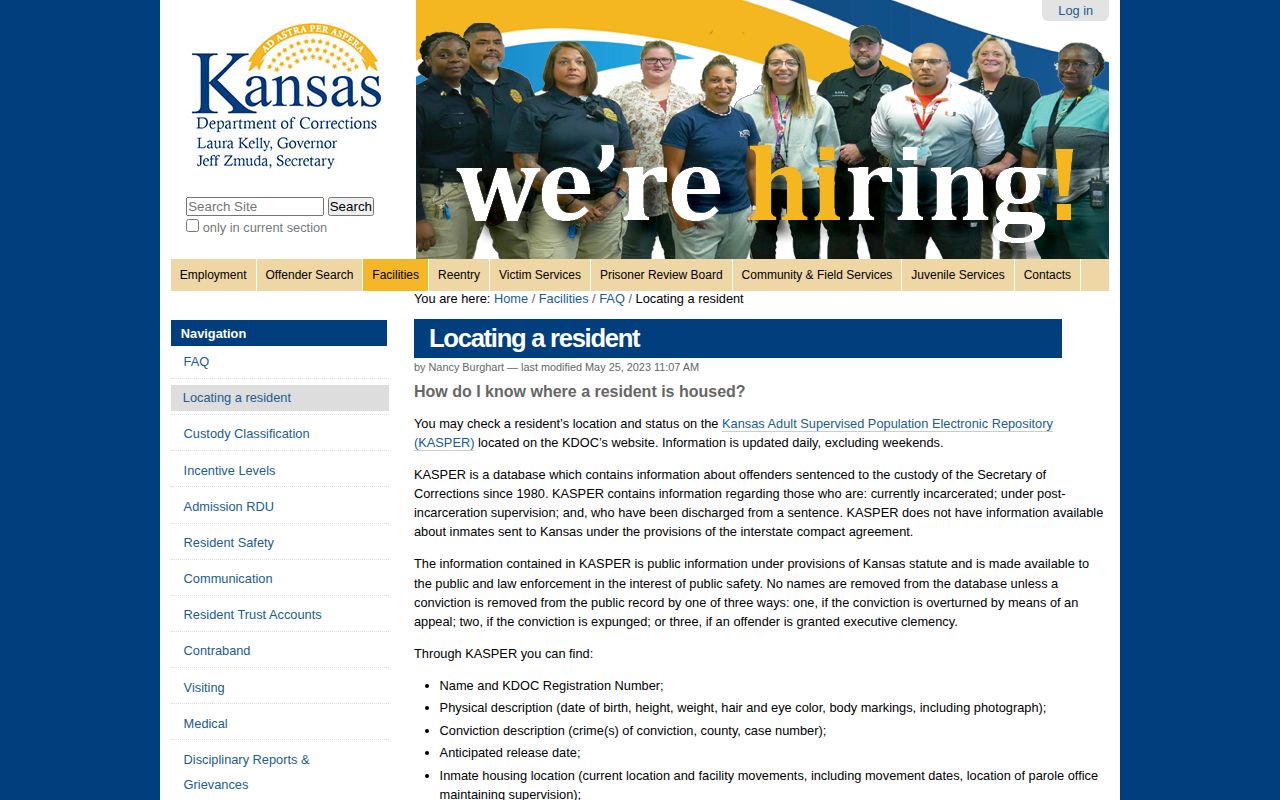
The guide supports using status, movement, sentence, and supervision fields as a coordinated record rather than reading one date in isolation.
Read Kansas Release Status
An incarceration location and custody level describe prison custody. Parole, conditional release, or postrelease supervision paired with a parole office indicates that the person left prison for supervised community status. “Sentence discharge” or a maximum-sentence discharge refers to completion of the sentence obligation. Movement dates can corroborate the transition.
| KASPER field | Proper interpretation |
|---|---|
| Facility or location | The prison or supervision location reported by KDOC |
| Movement history | Transfers and custody transitions recorded by KDOC |
| Parole office | The office responsible for KDOC community supervision |
| Anticipated release date | A changeable forecast, not proof of exit |
| Discharged status | Evidence that the KDOC sentence obligation ended |
KASPER updates each working day, not continuously. A same-day transition may lag. The repository also warns that absconder information can change after an update. An absconder status generally means the supervising agency alleges loss of contact or compliance. It does not itself prove new incarceration or sentence discharge.
Kansas Anticipated Release Date
KDOC’s exact public label is “Anticipated release date.” It is calculated from the sentence structure, custody credit, and applicable earned credit. It can move after disciplinary action, credit forfeiture, program completion, sentence correction, a court order, or changes in controlling consecutive and concurrent terms. The Projected Release Date page explains those variables.
For many qualifying post-July 1, 1993 sentences, Kansas law allows maximum good time equal to 15 percent of the prison portion. Some specified offense levels and dates use a 20-percent maximum, and limited program credit may apply. These are caps, not promises. A universal claim that every Kansas prisoner serves 85 percent would be false.
KDOC Release Records Contact
KDOC accepts public-record requests for releasable offender material. Identify the full name, KDOC number, case, conviction county, and requested date range. Useful records include a discharge certificate, movement or release record with actual date and type, sentence computation record, an applicable final Prisoner Review Board decision, and a recent releasable photograph.
714 SW Jackson, Suite 300
Topeka, KS 66603
785-296-3317
KDOC offender, sentence, movement, release, and discharge records
The published public-record contact is Nancy Burghart, Public Service Administrator, at Nancy.Burghart@ks.gov. Reasonable actual copying, access, and staff costs may apply. KDOC need not create a report, and proof of identity may be required where relevant. The three-business-day point in the KORA material concerns a response or initial determination, not guaranteed completion of a complex production.
For a public KASPER correction, KDOC provides kdoc_pub@ks.gov. Direct a county jail booking error to the Linn County Sheriff and a court-docket error to the clerk. Each agency is best placed to correct the record it created.
Linn County Parole Office
The Olathe Parole Office serves Linn, Johnson, and Miami counties for KDOC parole and postrelease work. It is located at 804 North Meadowbrook Drive, Suite 100, Olathe, Kansas 66062, with a published number of 913-829-6207. A KASPER detail can identify the assigned parole office. Verify supervision through the office shown on the current record.
Court probation and community corrections are separate from KDOC parole. The Sixth Judicial District Community Corrections Linn office is at 308 Main Street, Suite 106, Mound City. KASPER warns that current community-corrections probation events have not been available there since April 21, 2021 during data modernization. Use the local office and court docket for present probation status.
- Parole
- Conditional community release for an eligible sentence under board authority.
- Postrelease supervision
- A required community portion following many determinate prison sentences.
- Probation
- Court-ordered community supervision that may occur without prison.
- Discharge
- Completion of the corrections sentence obligation.
Kansas Prison Review Decisions
The Kansas Prisoner Review Board handles applicable discretionary parole matters and sets conditions in other release contexts. Not every modern Kansas prisoner receives a traditional parole-suitability hearing. Determinate postrelease dates follow the sentence and credits, while older indeterminate and specified off-grid cases can involve eligibility and board action.
Published board outcomes include parole, continue, and pass. “Continue” postpones a decision for more information or deliberation. “Pass” denies parole for an interval. Eligibility only means the Board may consider release; it is not a grant. No official public person-by-person decision-result search was found. Later KASPER movement can show whether release occurred, and a focused KDOC request can seek an applicable final decision.
The official Prisoner Review Board process explains these distinct decision paths.

The process is relevant only for the sentence types placed under Board authority, not every Linn County jail or prison release.
From Linn Jail to KDOC
A person does not enter the state search merely by appearing in the Linn County roster. The court must commit the person to KDOC custody, and the county jail’s disposition should show the handoff. Search the Linn case for the judgment and sentence, request the jail destination, then allow for creation and update of the state record.
Kansas VINE is not the state-prison source. The Kansas Attorney General expressly limits Kansas VINE to adult offenders in participating county jails and excludes KDOC offenders housed in state prisons. Use KASPER for the prison record. If KASPER has no match, recheck the KDOC number, spelling, conviction county, and whether the case ever resulted in state custody.
A transfer from Linn Jail to KDOC ends Linn’s physical custody but does not return the person to the community. Likewise, release from prison into postrelease supervision ends confinement while the sentence continues. Accurate language names both the custodian and the status.