
Linn County Three-Day Releases
No official Linn County 72-hour release feed was found. The county maintains a Current Inmate Roster and a direct, timestamped jail feed. Both describe current listings. Neither offers a rolling release window, archive, date filter, or retained list of names that left during the prior three days. The official route is to define the interval and obtain the existing release-log or booking-and-release records for it.
A three-day request can catch changes that a single present-time roster check cannot. It can also cover the span between a saved Friday entry and a later Monday review. Yet the wider range needs more care, not less. Linn County commission reports separate releases from farm-outs. A farm-out is a move to another jail bed, so it must not be counted as community release.
Check Linn County 72-Hour Releases
Build the three-day interval with records tied to dates and identifiers. Do not try to infer a rolling history from the present roster alone. A saved roster, court docket, or VINE alert can supply leads, while the Sheriff’s release entry provides the county’s actual time and disposition. For events confined to today, the Linn County 24-Hour Release List process uses a narrower same-day method.
- Set exact start and end timestamps for the 72-hour period, including the time zone. Use dates and times, not just “over the weekend.”
- Review any saved Linn County roster entries or case identifiers from the start of the interval. Note inmate numbers, booking times, case numbers, hold reasons, and bond fields.
- Check the Kansas court portal for bond, dismissal, sentencing, probation, commitment, or other orders entered during the range.
- Submit a focused county records request for the existing release log or booking-and-release records covering that exact interval.
- For every returned row, read actual release time, type, authority, and destination. Separate community departures from transfers, farm-outs, and commitments.
- Follow the destination. Use KASPER for a state commitment, the receiving county for a farm-out, BOP for a supported federal case, or ICE only when immigration custody is documented.
This process may yield fewer confirmed community releases than roster changes. That is expected. The point is to classify each outcome from the record rather than use absence as a substitute for evidence.
Linn County Three-Day Record Fields
The online feed shows identifiers that can make a three-day request more precise, but it lacks every field needed to confirm release. Ask for the existing jail record rather than asking staff to create a new report. The desired result should connect the booking to the exact exit event.
| Field | Use in a 72-hour reconstruction |
|---|---|
| Full name and inmate number | Matches a release row to the correct current or former booking. |
| Booking date and time | Separates multiple stays and confirms the booking that began before the interval. |
| Case number and hold reason | Points to the controlling court or another agency that may receive the person. |
| Actual release date and time | Places the jail event inside or outside the defined three-day span. |
| Release type or disposition | Identifies bond, court authorization, sentence completion, transfer, or another recorded outcome. |
| Authorizing court or agency | Connects the physical exit with its legal basis. |
| Destination or receiving agency | Shows whether the person entered the community or remained in another custodian’s control. |
The official Linn County live feed is pictured below because it shows the timestamp and current-booking fields that should be preserved before a row is removed.
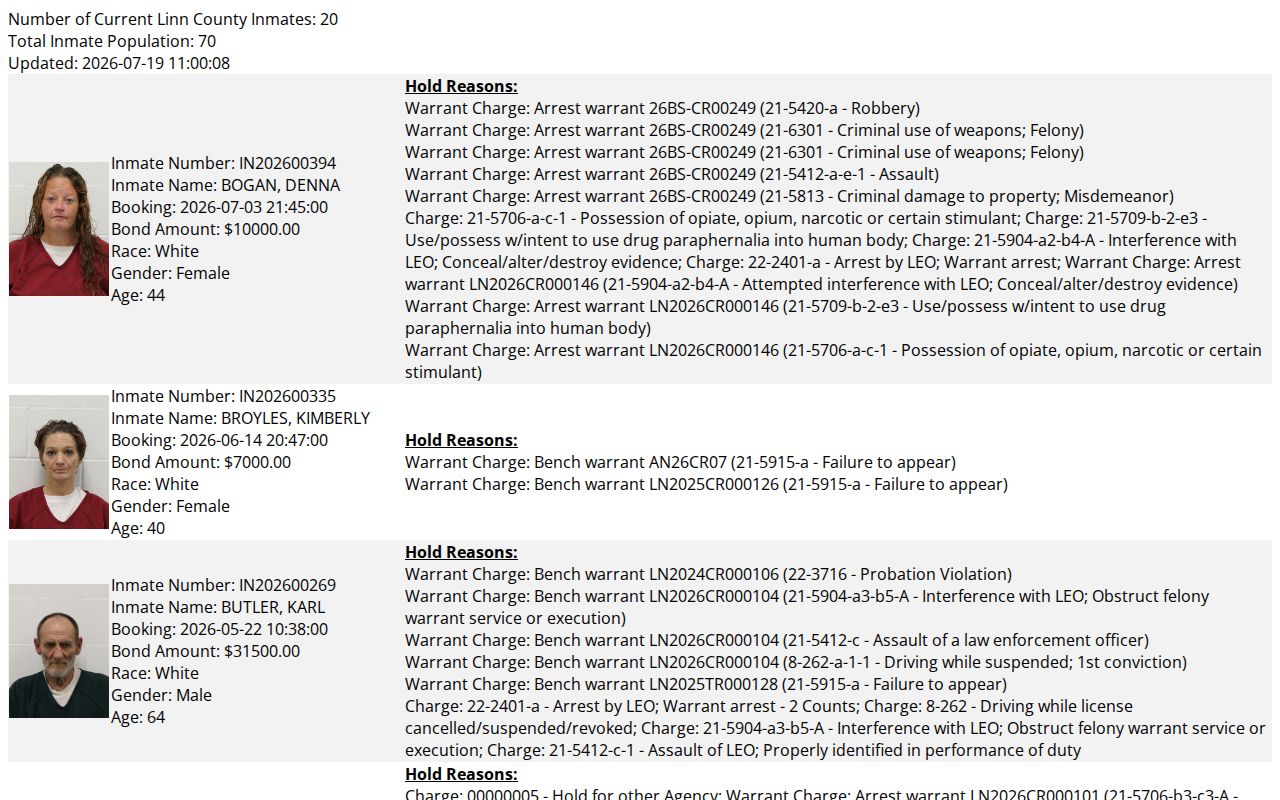
The screenshot documents the current-only format. It does not turn the roster into a historical release source or prove how long any removed row remains available.
Linn County Weekend Release Checks
Linn County publishes no special weekend or holiday release schedule. It also does not state a public release hour, exit door, family waiting place, or guaranteed roster refresh rate. A three-day window is useful because it spans more than one daily check, but it should not be used to invent a weekend processing rule. Use the jail’s recorded event time.
Court action and physical exit can occur at different points. A bond order or sentence event may authorize release, while jail staff still complete record work, return property, check for warrants, and address any other holds. Kansas requires a warrant query before an incarcerated person is released. A new warrant or outside hold can change the final destination even when the original case appears complete.
For one person, contact the Linn County Sheriff about a recorded time and destination. For a group of weekend releases, state the full interval on the KORA form. A range from Friday afternoon through Monday afternoon is clearer than “last weekend,” and it reduces disputes about which boundary applies.
Note: The public roster’s precise update stamp shows when the page was generated, not when each release was processed.
Request Linn County 72-Hour Records
Use Linn County’s KORA request form and fee schedule for the interval. Request an existing release log if one is maintained, plus enough fields to classify the outcome. If the inquiry concerns one name, include the booking number and case number. Ask for electronic delivery and an estimate before costs pass a stated amount.
The county form lists email delivery at no charge. Search, review, redaction, and compilation time can still be charged at the stated rate, prorated in fifteen-minute units. A broad request for every record in a span may cost more than a named-person request. Kansas law calls for agency action or a detailed delay response by the end of the third business day, not guaranteed production of a large record set within that time.
Use other sources in parallel. VINELink can send a prospective county-custody event when the record and alert were available, but it may lag and does not always explain the release type. KASPER is for people sentenced to the Kansas Secretary of Corrections, not every county booking. Court records explain legal authority, while the Sheriff’s record supplies the actual jail exit.
Linn County Roster Population Quirks
The Linn County feed presents separate counters for “Number of Current Linn County Inmates” and “Total Inmate Population.” It does not define every component of the difference. Commission minutes document that Linn County routinely houses farmed-in prisoners and sometimes sends prisoners elsewhere, so cross-jurisdiction custody is a real local factor. Still, the records do not support assigning each person in the total counter to a specific outside jurisdiction without the booking data.
This distinction is central to a 72-hour release reconstruction. A row tied to another county may be removed because that county reclaimed the person. A Linn case may end in a farm-out while custody continues. Inspect case prefixes, hold reasons, and receiving-agency fields. Then confirm the destination with the agency that took control.
County commission reports treat releases and farm-outs as separate lines of activity. A sound three-day count should do the same. Report a community release only when the disposition supports it. Keep transfers in their own category.
Linn County Release Versus Transfer
“Released from Linn County Jail” can mean only that the Sheriff’s physical custody ended. The next destination determines the larger outcome. A person who leaves on bond or after a sentence may return to the community. Someone delivered to KDOC, another jail, a federal custodian, or immigration custody remains confined under a new authority.
| Recorded outcome | Correct next check |
|---|---|
| Bond, court order, time served, or completed local sentence | Confirm the jail’s actual exit time and review the court docket for ongoing case or probation terms. |
| Farm-out or county transfer | Contact the named receiving jail and retain the transfer destination from the Linn record. |
| KDOC commitment | Search KASPER after state intake and read movements and status in context. |
| Federal transfer | Use the Bureau of Prisons locator only when the case or transfer record supports federal custody. |
| Immigration transfer | Use the ICE locator only when an immigration hold or destination is documented. |
A current-custody roster is not a release archive. Likewise, an “Anticipated release date” in KASPER is a forecast rather than proof that the person left prison. For a named person whose path is unclear, the Linn County released-inmate lookup follows each custody branch without assuming all jail stays become KDOC cases.
Verify Linn County Release Results
Reconcile at least two layers when timing matters. The court docket can show the order that allowed or required release. The jail record can show when Linn County carried it out. A receiving locator or agency record can show whether custody continued elsewhere. VINELink can add a useful alert, but its event should be confirmed by the originating agency.
- Release disposition
- The jail’s recorded reason or outcome for ending its custody.
- Farm-out
- A placement in another jurisdiction’s jail bed. It is not a return to the community.
- State commitment
- A transfer into KDOC custody after a qualifying sentence.
- Discharge
- The end of a sentence obligation, which differs from leaving one jail while another duty or supervision term remains.
Names alone are weak identifiers. Match the inmate or booking number, date of birth when lawfully displayed, case number, and dates. Similar names and same-named Linn counties in other states can produce false matches. Keep every search within Kansas sources tied to the known case.