
Understanding Linn County Released Inmates
A release record documents the end of one agency’s physical custody. It is not the same as an arrest record, court judgment, or current roster entry. Someone released from Linn County Jail normally drops from the public live feed because that feed is limited to people listed now. The Sheriff’s underlying booking-and-release entry remains the best source for the actual exit time, release authority, and destination when those fields are releasable.
The word “released” needs a custodian. Bond, a court order, time served, sentence completion, or dismissal may end county confinement and return a person to the community if no other hold remains. A farm-out, state commitment, or pickup by another agency ends Linn County Jail custody while confinement continues elsewhere. Release from a Kansas prison may lead to parole or postrelease supervision. Sentence discharge is different because it indicates that the KDOC sentence obligation ended.
- Time served
- The court credits enough confinement to satisfy the custodial part of a sentence.
- Parole
- Release from prison under KDOC supervision for a sentence eligible for a parole decision.
- Probation
- Court-ordered community supervision that may occur without a state-prison term.
- Discharge
- The end of the sentence obligation, not merely departure from one facility.
- Detainer
- A request or hold that may cause another agency to take custody when the current matter ends.
Linn County Release Types
Linn County has not published the literal release codes used in its jail database. Common categories can still explain how a departure works, but they should not be presented as the Sheriff’s exact labels. The release sheet controls. It should identify the actual disposition and, when recorded, the court or agency that authorized it.
| Release type | What it means | Next record |
|---|---|---|
| Bond or own recognizance | County custody ends while the criminal case normally continues. | Jail release entry and court docket |
| Time served or local sentence complete | The ordered jail portion ends, though probation or another hold may remain. | Judgment, jail credit, and release entry |
| Dismissal or court order | The listed case permits release if no other matter keeps the person held. | Court order plus jail exit record |
| State commitment | The person moves into Kansas Department of Corrections custody. | KASPER after state intake |
| Farm-out or transfer | A receiving jail or agency takes control. | Destination field and receiving locator |
| Parole or postrelease | Prison confinement ends while KDOC supervision continues. | KASPER status and parole office |
A dismissal alone does not guarantee that someone walked free. Another warrant, case, or outside hold may control the final outcome. Kansas law also requires a warrant database check before an incarcerated person is released, so a late-discovered warrant can change the destination.
Linn County Release Record Fields
Ask for an existing booking-and-release sheet, jail management entry, or equivalent. A precise field request is more useful than asking for “all inmate information.” It also helps staff locate one booking and limits avoidable search time. The following inventory combines the identifiers needed to match the person with the facts needed to classify the exit.
| Field | What it shows |
|---|---|
| Full name and booking number | Connects the release to the correct jail stay. |
| Booking date and time | Separates multiple admissions for the same person. |
| Arresting and holding agency | Identifies which office brought and controlled the booking. |
| Charges, holds, and case number | Links the custody record to the controlling court or outside agency. |
| Bond | Records the bond tied to the booking; it is not by itself proof of release. |
| Actual release date and time | Shows when Linn County completed the physical exit. |
| Release type or disposition | Explains the recorded outcome, such as a community release or transfer. |
| Authorizing court or agency | Identifies the source of legal authority. |
| Destination or transfer agency | Distinguishes return to the community from continued custody. |
| Sentence-credit calculation | Shows local credit detail if it exists in the releasable record. |
| Booking photograph | Helps match the booking, subject to lawful closure or redaction. |
The court docket supplies a different layer. It can show bond, judgment, sentence, jail credit, probation, dismissal, revocation, or commitment. It may not show the minute that staff returned property and completed release. Reconcile the legal event with the jail’s actual release entry.
Request Linn County Release Records
Use the official Linn County KORA request form. Route the request to the office that created the source record. The Sheriff is the source for its jail booking and release entry. The District Court clerk is the source for filed court orders. KDOC handles state sentence, movement, supervision, and discharge records.
- Identify the person, booking number, case number, and exact date range. Avoid a broad request when one stay is at issue.
- Ask for the existing booking-and-release sheet or equivalent, including actual time, disposition, authority, and destination.
- Select electronic delivery and state whether a booking photograph is also requested.
- Ask for an itemized estimate before work exceeds a stated amount. The county may require prepayment.
- Keep the agency response. If more time is needed, it should give an explanation and estimated availability.
308 Main Street, Suite 103
Mound City, KS 66056
Monday through Friday, 8:00 a.m. to 4:00 p.m.
Verify the current nonemergency number in the county directory.
K.S.A. 45-218 calls for action on a request as soon as possible and no later than the end of the third business day. That means a response, access, or a detailed delay notice. It is not a promise that a complex production will finish within three business days.
Linn County Release Record Law
The Kansas Open Records Act, beginning at K.S.A. 45-215, favors access unless a specific exemption applies. K.S.A. 45-218 addresses access and response timing. K.S.A. 45-219 permits reasonable actual-cost fees. K.S.A. 45-221 lists records that may be closed, including categories tied to privacy, active investigations, medical facts, security, juvenile matters, and other restrictions.
Linn County’s fee schedule lists black-and-white pages at $0.25, color pages at $0.50, certified copies at $1 per document, and email delivery at no charge. Media is billed at actual cost. Search, review, redaction, and compilation are listed at $30 per hour, prorated to fifteen minutes. A narrow request can reduce work. For larger expected staff costs, Kansas law also supports an interactive effort to narrow the scope.
Expungement is a court remedy, not release. K.S.A. 21-6614 addresses many conviction expungements, while K.S.A. 22-2410 addresses arrest records. Eligibility and waiting periods depend on the offense and disposition. A granted order may remove a case from ordinary public access and can affect KASPER, but no rule supports promising that all internal, cached, or privately held copies vanish.
Linn County Release-Day Logistics
Linn County’s detention operations description states that staff calculate entry and release dates, keep jail records, and release prisoners only on proper authorization. Staff also return personal property and clothing at authorized release. This local source confirms an administrative release process beyond what the public roster shows.
The county does not publish a release hour, exit door, family waiting area, weekend routine, or transportation plan. Contact the Sheriff for time and place questions. A court event can authorize release while staff still complete warrant checks, records, and property return.
Linn County Release Property Corrections
If an expected item or release field is wrong, identify the booking and begin with the office that created that part of the record. The Sheriff handles its jail record and property process. Send a docket error to the District Court clerk. Send a KASPER identity, status, or movement concern to KDOC at its published correction address.
Keep the systems separate. The court may correct an order without changing what the jail recorded at the moment of exit. KDOC may correct a state record that never applied to a county-only stay. A booking number, case number, date, and clear description of the disputed field help route the issue.
Linn County Bond Release Evidence
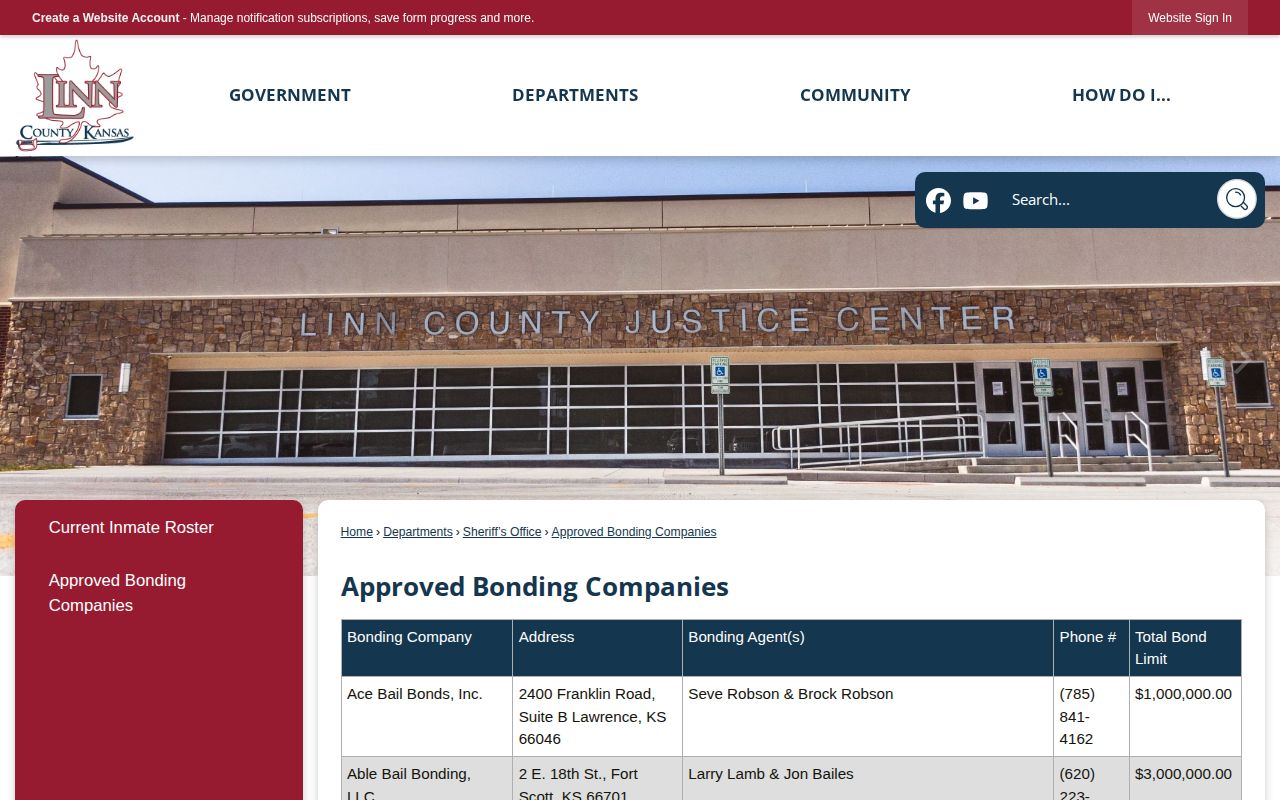
The live roster displays a bond amount, and the county maintains an approved bonding-company table. Neither proves that bond was posted or that release processing finished. The official list identifies approved firms, agents, contact details, and total bond limits. It is not a transaction log.
The image below shows the official Linn County bonding-company page.
Use the court event to confirm the bond order and the jail record to confirm the actual exit. Another case or hold can keep the person confined even after bond is resolved in one matter.
Linn County Release Activity Snapshot
The May 26, 2026 sheriff report gives a local snapshot, not an annual rate or average stay. It records releases and cross-jurisdiction movements as separate activity. That distinction helps explain why a roster change must be classified before it is called a community release.
The report also lists 4,203 jail contacts for its reporting period. These figures should not be projected into yearly totals. They show only that release, farm-in, farm-out, and jail-contact measures describe different kinds of work.
Search Linn County Released Inmates
Start with the custody type rather than one broad name search. Linn County publishes no recent-release feed. The current roster can preserve identifiers before a row disappears, while the jail release record proves the county event. KASPER serves state sentences. VINE serves participating Kansas county-jail events. Court, BOP, and ICE sources apply only when the case path supports them.
- Check the Linn County live roster. If the person appears, record the inmate number, booking time, case numbers, holds, and page timestamp.
- If absent, search the Kansas court portal for bond, dismissal, time served, probation, commitment, or another release-authorizing event.
- Request the Sheriff’s booking-and-release sheet, including destination. This separates community release from transfer.
- Use KASPER only if the case led to KDOC custody. Read supervision and discharge values in context.
- Use Kansas VINELink for a participating county-jail record and confirm any alert with the Sheriff.
- Use BOP for a supported federal case and ICE only when immigration custody is documented.
- Match booking, KDOC, or case numbers and dates. Do not combine records for similar names.
KASPER Linn County Release Search
KASPER is the Kansas Adult Supervised Population Electronic Repository. It covers people sentenced to the Secretary of Corrections since 1980 who are incarcerated, under post-incarceration supervision, or discharged. It does not cover every Linn County Jail booking. A person who bonded out, served a county term, or received local probation may never appear.
| Search field | How it helps |
|---|---|
| Last, first, middle, or alias | Begins a name search and checks known alternate names. |
| KDOC number | Provides the strongest direct match to a state record. |
| Birth date or age range | Separates similar names. |
| Race and gender | Additional identity filters, not substitutes for an ID number. |
| Conviction county | Can narrow results to Linn County convictions. |
| Parole supervision county | Can find people supervised in Linn even if convicted elsewhere. |
| Photo or thumbnail | Supports identity matching with the rest of the record. |
Open the detail and read movements, supervision type, parole office, custody level, sentence data, and discharge in context. “Anticipated release date” is a forecast. It is not proof that prison custody ended. A parole or postrelease status means prison confinement ended while supervision continues. A discharged status or maximum-sentence discharge is stronger evidence that the KDOC obligation ended.
The official KASPER entry is pictured below.
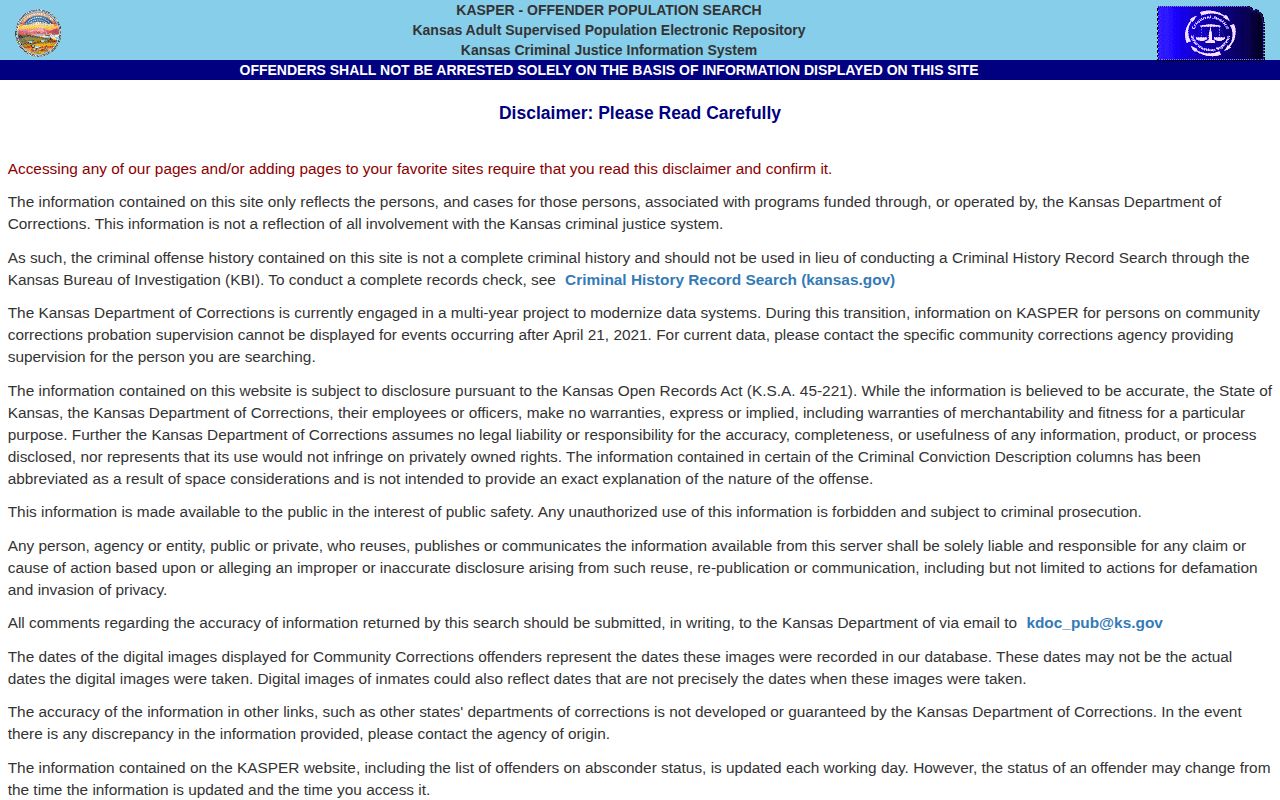
The state record is durable for qualifying KDOC cases, but it should never be used as though every county detainee becomes a state prisoner.
Linn County Recent Release Search
Linn County has no official 24-hour or 72-hour released-inmate feed. The official roster shell and direct feed show current entries, photographs, booking fields, bond, demographics, and hold reasons. They show no release date, reason, destination, authority, archive, or search control. No published refresh promise or post-release retention period was found.
The official current-roster screen appears below to demonstrate that limit.
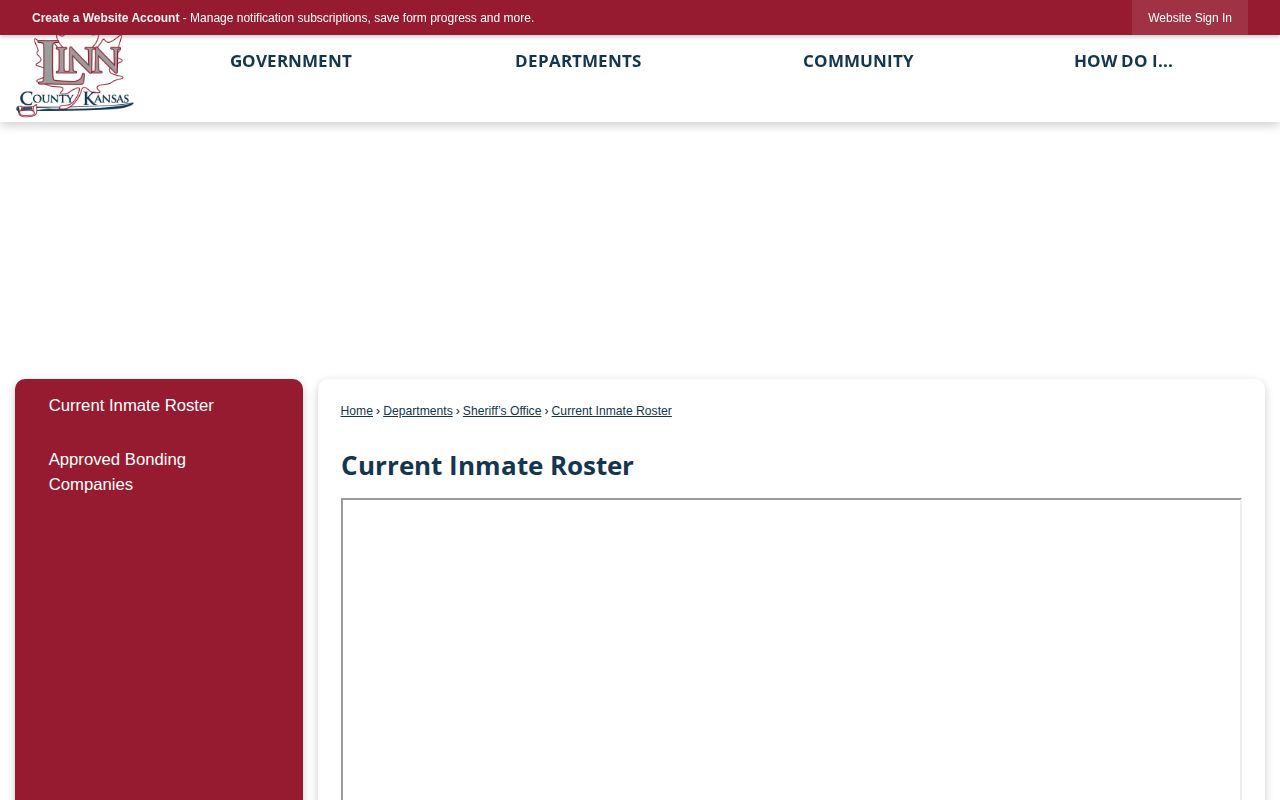
For one recent departure, preserve the identifiers and request the release sheet. For a time range, give exact start and end timestamps and ask for existing release-log fields. Email delivery itself carries no listed charge, though staff search and review time may apply.
Linn County Release Supervision Search
KDOC parole and postrelease supervision are checked through KASPER and the Olathe Parole Office, which serves Linn, Johnson, and Miami counties. Court probation is separate. Sixth Judicial District Community Corrections has a Linn County office in Mound City. That office is the current-status fallback because KASPER warns that its community-corrections probation events have not been current since April 21, 2021.
A parole or probation violation on the jail roster means the person is now held on an alleged violation. It does not erase the fact of an earlier release. Record the new case or warrant information, then reconcile the new booking with the supervision record. The Linn County parole and probation page explains the two systems and local offices in depth.
Linn County Release Alert Sources
Kansas VINELink supports custody information and notifications for adult offenders in participating Kansas county jails. The Kansas Attorney General expressly excludes KDOC offenders housed in state prisons, so KASPER remains the state-prison source. VINE can report a release or transfer event, but the alert may not state whether the cause was bond, time served, dismissal, or a custody handoff. Confirm exact facts with the Sheriff.
Federal and immigration systems are conditional branches. A released federal prisoner may appear in the BOP Inmate Locator with a release date or a “Not in BOP custody” result. That does not rule out supervised release or another custodian. Use the ICE locator only when a documented immigration hold or transfer points there. No federal prison, ICE facility, or ICE contract was verified in Linn County.
Linn County Release Court Reconciliation
Roster hold reasons can show another county’s case prefix, a probation or parole violation, or a generic other-agency hold. Search the court identified by the case number. Linn County criminal cases commonly use an LN prefix, but the roster may carry a different county code. An outside prefix is a routing clue, not proof of release.
The Kansas public portal can show parties, case type, judge, hearings, and available filed documents. A courthouse terminal or written court-record request may reveal public material that is not remotely available. An empty online result does not mean there was no case, dismissal, or release because older, sealed, expunged, juvenile, restricted, and non-electronic records have different access paths.
Linn County Release Hold Destinations
A generic “hold for other agency” does not name the destination. Before describing someone as released, request the release disposition and receiving agency. A farm-out may lead to another county jail. A state commitment leads to KDOC. A supported federal transfer leads to a federal custodian. An immigration detainer can lead to ICE custody.
No local ICE detention facility or contract was verified. The ICE Online Detainee Locator should be used only when the known record supports immigration custody. Likewise, the BOP locator applies to a federal case, not merely a missing county roster name. The receiving record completes the custody trail.
Linn County Release Source Comparison
Choose the source that owns the event. A current roster, county release record, state corrections record, and federal locator do not cover the same population.
| Status or system | Correct source | What it can establish |
|---|---|---|
| Listed in county jail now | Linn County live roster | Current listing at the page timestamp |
| Released or transferred from county jail | Sheriff booking-and-release record | Actual time, disposition, authority, and destination |
| State prison, supervision, or discharge | KASPER and KDOC records | Movement, status, parole office, and sentence discharge |
| Court authority or continuing case | Kansas court portal and district clerk | Bond, judgment, sentence, probation, dismissal, or commitment |
| Participating county-jail alert | Kansas VINELink | Reported custody event that still needs agency confirmation |
| Federal prison release | BOP Inmate Locator | BOP location or release result for a federal prisoner |
Linn County Release Facilities
One operating detention facility was verified inside Linn County. The other entries below are statewide or national systems that may receive or release a person whose case took that path. They are not physical Linn County facilities.
- Linn County Jail holds county pretrial, local-sentence, warrant, violation, and other-agency prisoners. Its release record distinguishes community exit from transfer.
- Kansas Department of Corrections Institutions house state prisoners at assigned locations. KASPER is the public post-prison and discharge route.
- Federal Bureau of Prisons Institutions apply only to federal custody. BOP can show a federal release date or noncustody result.
- ICE Detention System applies only when immigration custody is documented. No local ICE facility was verified.
The current Linn County Jail is in the Justice Center. The historic Old Linn County Jail is a heritage site, not the place to search for a current or released person. Commission reports and detention duties describe an active modular jail with farm-in and farm-out activity.
Linn County Release Facility Location
The operational Linn County Jail is in the Justice Center at 308 Main Street, Suite 103, Mound City. Detention materials refer to modules or pods and mostly indirect supervision. Staff duties include transport to court, medical appointments, and other institutions, which supports the need to distinguish a transfer from community release.
The Old Linn County Jail is part of local history. It is not the modern custody-search destination. Current release questions, booking identifiers, property issues, and transfer destinations belong with the Sheriff at the Justice Center.
Linn County Release Roster Counters
The live feed separately labels “Number of Current Linn County Inmates” and “Total Inmate Population.” Official commission reports document many farmed-in prisoners, so cross-jurisdiction placements likely contribute to the distinction. The feed does not define every component, however. It would be unsupported to assign the full difference to one outside agency.
Use case prefixes and hold reasons to identify the controlling jurisdiction. Then request the destination before calling a disappearance a release. The two counters are population measures, not released-inmate totals, and neither replaces the booking-and-release record.